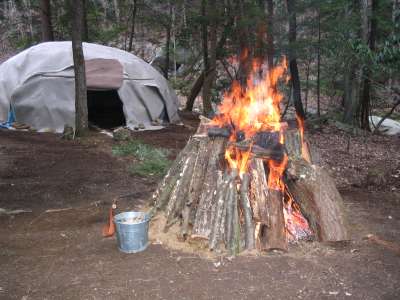
I knew at some point in the semester I was going to write about some sort of folk architecture because I had an interesting experience with one a few years back. When I was a little younger, I went to Camp Palawopec, an outdoorsy camp in Brown County in southern Indiana. The session lasted for a week, and on the last night, all the girls went into what was called a sweat lodge. It was like a dome shaped structure that looked like it was made out of clay or something with that consistency. Inside, there was a center pit with stones and a little water that the counselors poured over the stones to create the steam to make everyone sweat. We were told that the purpose of this experience was to sweat out all the “bad stuff” and then after a while we’d jump in the lake to cool ourselves off. I thought it was kind of silly, but I really did feel relaxed after the whole situation was over. I guess I felt more or less completely exhausted, so I slept amazingly well that night! If you are interested in learning more about the camp, check out their website at http://www.camppalawopec.com.
This experience spurred me to learn more about sweat lodges and where they really come from. I learned that it is difficult to find the real origin of this type of architecture, but generally they are part of the Native American culture (www.wikipedia.com). They can be made from several different kinds of things, including clay, wood, willow tree branches, etc. The shapes of the lodge can also vary from being dome above ground to being an area that has been dug out and had branches placed over it. The idea of heating stones and then placing them in the center of the lodge seems to be universal with sweat lodges (www.wikipedia.com). It seems that the legend or notion behind the reasons for the sweat lodge is that it was given to the people by their Creator in order to provide direct communication between each other. Similarly, the lodge is seen as a womb, bringing both life and death to the people (www.wikipedia.com). It can involve very sacred rituals and traditions that involve cleansing the body, mind, spirit and heart. It seems that all the essential parts involved in the creating of the lodge and the ceremonies are extremely important to the people who participate in these activities. They give thanks for all the blessings they receive (www.wikipedia.com).
What was really interesting to me was the amount of ritual and tradition involved in the whole experience. Traditionally, the door faces the fire, the people who build the lodge do so in silence--some groups may have a drum playing and others may not eat while it is being built (www.wikipedia.com). Although nowadays, people may wear whatever they want to inside, traditionally people went in without any clothes on. Often people present offerings such as tobacco or sweet grass as a way of giving thanks for the blessings given to them. It seems that one of the most important aspects of the lodge is to show immense respect towards the lodge leader. This is why people often are silent during the ceremony, or maybe chanting quietly. This can also help show thanks for the leader and support for the group within the lodge. It seems that overall, the idea of the sweat lodge is to be thankful for everything one is given to live and survive. It clearly can be a religious experience for some, and for others maybe just a ritualistic tradition to purify everyone. Either way, it definitely calmed me down and helped to relax me. The information about the sweat lodge can be found at www.Wikipedia.com. The photo is of a sweat lodge from Abram's Creek Retreat & Campground in West Virginia. It can be found at http://www.abramscreek.com/images2/lodge_Picture%20083.jpg. This post is my response to the Architecture Encounter Project.
This experience spurred me to learn more about sweat lodges and where they really come from. I learned that it is difficult to find the real origin of this type of architecture, but generally they are part of the Native American culture (www.wikipedia.com). They can be made from several different kinds of things, including clay, wood, willow tree branches, etc. The shapes of the lodge can also vary from being dome above ground to being an area that has been dug out and had branches placed over it. The idea of heating stones and then placing them in the center of the lodge seems to be universal with sweat lodges (www.wikipedia.com). It seems that the legend or notion behind the reasons for the sweat lodge is that it was given to the people by their Creator in order to provide direct communication between each other. Similarly, the lodge is seen as a womb, bringing both life and death to the people (www.wikipedia.com). It can involve very sacred rituals and traditions that involve cleansing the body, mind, spirit and heart. It seems that all the essential parts involved in the creating of the lodge and the ceremonies are extremely important to the people who participate in these activities. They give thanks for all the blessings they receive (www.wikipedia.com).
What was really interesting to me was the amount of ritual and tradition involved in the whole experience. Traditionally, the door faces the fire, the people who build the lodge do so in silence--some groups may have a drum playing and others may not eat while it is being built (www.wikipedia.com). Although nowadays, people may wear whatever they want to inside, traditionally people went in without any clothes on. Often people present offerings such as tobacco or sweet grass as a way of giving thanks for the blessings given to them. It seems that one of the most important aspects of the lodge is to show immense respect towards the lodge leader. This is why people often are silent during the ceremony, or maybe chanting quietly. This can also help show thanks for the leader and support for the group within the lodge. It seems that overall, the idea of the sweat lodge is to be thankful for everything one is given to live and survive. It clearly can be a religious experience for some, and for others maybe just a ritualistic tradition to purify everyone. Either way, it definitely calmed me down and helped to relax me. The information about the sweat lodge can be found at www.Wikipedia.com. The photo is of a sweat lodge from Abram's Creek Retreat & Campground in West Virginia. It can be found at http://www.abramscreek.com/images2/lodge_Picture%20083.jpg. This post is my response to the Architecture Encounter Project.
