Saturday, December 8, 2007
*Italy*
I have always been fascinated by the lifestyles in Italy, so I think if I had the money and the time, I’d love to explore that more in depth. I really enjoy the idea that they seem to have huge families who love to come together and laugh and eat and enjoy each other. I guess it seems like they have much less stressful lives than “Americans” do, possibly because of their “relaxed” attitude I seem to admire so much. I do have a few friends who have family in Italy, so I think I would start there. I would want to ask my friend questions about her family and rituals and traditions that are important to them, that are also specific to being Italian. If possible, I would love to get a first-hand account of Italian life by living in the house with the family. I would interview the family members about why the Italian culture is important to them, and what they believe others should know about their culture. I would bring a camcorder to record different situations that occurred while I was staying with them, like the preparation of a traditional Italian meal and all the conversations that go on at the dinner table. I’d ask general questions about their traditions as well as more in depth follow up questions about things I found really interesting. According to the book, since I am not Italian, but find their culture really amazing, I’d consider myself an outsider (Sims and Stephens, p. 219). Knowing this, I would find out as much from my friend before taking on this challenge so I would have a foundation to start with. I think this would be worth doing because learning about different cultures is very important because it seems like there are similarities between all cultures in one way or another. In order to be more open-minded and more educated in general, I think people should have an understanding of all that is within the world around them. Another important reason to do this would be that continually learning about something helps keep it alive to people. I think sometimes people make jokes about things when they don’t understand them, and if people know more about cultures, it gives them a chance to learn something new. In this case, maybe learning why Italian families take so much pride in family and food, and being loud and alive, others may feel more comfortable putting themselves in new situations and end up learning more about themselves and others. This blog entry is my response to the Chapter 7 Reflection Question.

Sunday, December 2, 2007
Folklore + Freud??
I think the interpretation I find myself gravitating towards is the psychoanalytic interpretation. This may be because I am a psychology major, so anything dealing with psychological perspectives kind of draws me in. I guess I think that the way it is explained, how “a culture’s folklore presents a look at its collective psychological concerns,” really makes sense (Sims and Stephens, pp. 187). I think that is true, that the way you do things, through ritual and tradition, telling stories, all have a broader meaning that could deal with personalities, child-rearing, developmental stages, etc (Sims and Stephens, pp. 187). Obviously different places and people will have different traditions and ways that they do things, and this interpretations shows that their folklore reflects upon many of their internal characteristics. I also thought it was really interesting how the authors mentioned that psychoanalysts can study certain texts to find “metaphors for puberty, sexual maturity, seduction and death,” (Sims and Stephens, pp. 187). The examples that were explained really made sense to me and I think they apply to a lot of other parts of folklore as well. It seems as though this approach involves the most in-depth look at the symbolism in folklore, which might be why I like it so much. It is almost as if different parts of our development, whether physical, emotional or mental, can be explained symbolically and be accepted as such through the use of folklore. Similarly, I do think that a lot of what people do has a much deeper meaning than it may seem on the surface. Gary Allen Fine explained this well when he said, “folklore provides a socially acceptable outlet for meaning that cannot be displayed otherwise. If the meaning was overt, the text would have to be repressed,” (Sims and Stephens, pp. 191). I think this approach is the best way to look deeper into folklore and bring out a lot if information that would not be explained as well with the other approaches. This blog entry is my response to the Chapter 6 Reflection Question.
Sunday, November 25, 2007
Sweating as Relaxation?
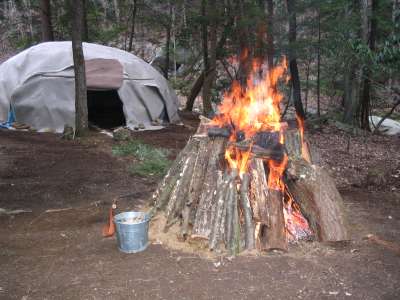
I knew at some point in the semester I was going to write about some sort of folk architecture because I had an interesting experience with one a few years back. When I was a little younger, I went to Camp Palawopec, an outdoorsy camp in Brown County in southern Indiana. The session lasted for a week, and on the last night, all the girls went into what was called a sweat lodge. It was like a dome shaped structure that looked like it was made out of clay or something with that consistency. Inside, there was a center pit with stones and a little water that the counselors poured over the stones to create the steam to make everyone sweat. We were told that the purpose of this experience was to sweat out all the “bad stuff” and then after a while we’d jump in the lake to cool ourselves off. I thought it was kind of silly, but I really did feel relaxed after the whole situation was over. I guess I felt more or less completely exhausted, so I slept amazingly well that night! If you are interested in learning more about the camp, check out their website at http://www.camppalawopec.com.
This experience spurred me to learn more about sweat lodges and where they really come from. I learned that it is difficult to find the real origin of this type of architecture, but generally they are part of the Native American culture (www.wikipedia.com). They can be made from several different kinds of things, including clay, wood, willow tree branches, etc. The shapes of the lodge can also vary from being dome above ground to being an area that has been dug out and had branches placed over it. The idea of heating stones and then placing them in the center of the lodge seems to be universal with sweat lodges (www.wikipedia.com). It seems that the legend or notion behind the reasons for the sweat lodge is that it was given to the people by their Creator in order to provide direct communication between each other. Similarly, the lodge is seen as a womb, bringing both life and death to the people (www.wikipedia.com). It can involve very sacred rituals and traditions that involve cleansing the body, mind, spirit and heart. It seems that all the essential parts involved in the creating of the lodge and the ceremonies are extremely important to the people who participate in these activities. They give thanks for all the blessings they receive (www.wikipedia.com).
What was really interesting to me was the amount of ritual and tradition involved in the whole experience. Traditionally, the door faces the fire, the people who build the lodge do so in silence--some groups may have a drum playing and others may not eat while it is being built (www.wikipedia.com). Although nowadays, people may wear whatever they want to inside, traditionally people went in without any clothes on. Often people present offerings such as tobacco or sweet grass as a way of giving thanks for the blessings given to them. It seems that one of the most important aspects of the lodge is to show immense respect towards the lodge leader. This is why people often are silent during the ceremony, or maybe chanting quietly. This can also help show thanks for the leader and support for the group within the lodge. It seems that overall, the idea of the sweat lodge is to be thankful for everything one is given to live and survive. It clearly can be a religious experience for some, and for others maybe just a ritualistic tradition to purify everyone. Either way, it definitely calmed me down and helped to relax me. The information about the sweat lodge can be found at www.Wikipedia.com. The photo is of a sweat lodge from Abram's Creek Retreat & Campground in West Virginia. It can be found at http://www.abramscreek.com/images2/lodge_Picture%20083.jpg. This post is my response to the Architecture Encounter Project.
This experience spurred me to learn more about sweat lodges and where they really come from. I learned that it is difficult to find the real origin of this type of architecture, but generally they are part of the Native American culture (www.wikipedia.com). They can be made from several different kinds of things, including clay, wood, willow tree branches, etc. The shapes of the lodge can also vary from being dome above ground to being an area that has been dug out and had branches placed over it. The idea of heating stones and then placing them in the center of the lodge seems to be universal with sweat lodges (www.wikipedia.com). It seems that the legend or notion behind the reasons for the sweat lodge is that it was given to the people by their Creator in order to provide direct communication between each other. Similarly, the lodge is seen as a womb, bringing both life and death to the people (www.wikipedia.com). It can involve very sacred rituals and traditions that involve cleansing the body, mind, spirit and heart. It seems that all the essential parts involved in the creating of the lodge and the ceremonies are extremely important to the people who participate in these activities. They give thanks for all the blessings they receive (www.wikipedia.com).
What was really interesting to me was the amount of ritual and tradition involved in the whole experience. Traditionally, the door faces the fire, the people who build the lodge do so in silence--some groups may have a drum playing and others may not eat while it is being built (www.wikipedia.com). Although nowadays, people may wear whatever they want to inside, traditionally people went in without any clothes on. Often people present offerings such as tobacco or sweet grass as a way of giving thanks for the blessings given to them. It seems that one of the most important aspects of the lodge is to show immense respect towards the lodge leader. This is why people often are silent during the ceremony, or maybe chanting quietly. This can also help show thanks for the leader and support for the group within the lodge. It seems that overall, the idea of the sweat lodge is to be thankful for everything one is given to live and survive. It clearly can be a religious experience for some, and for others maybe just a ritualistic tradition to purify everyone. Either way, it definitely calmed me down and helped to relax me. The information about the sweat lodge can be found at www.Wikipedia.com. The photo is of a sweat lodge from Abram's Creek Retreat & Campground in West Virginia. It can be found at http://www.abramscreek.com/images2/lodge_Picture%20083.jpg. This post is my response to the Architecture Encounter Project.
Sunday, November 18, 2007
Performances
If you asked me about performance before taking this class or reading this book, I probably would have only responded about it in terms of grand, formal public situations. I used to think that “performances” were just like musicals, concerts, football games, plays, etc. I thought of them as these huge, planned, public occurrences where people gathered to watch something being done. I was reading in the book about “performing proverbs” and to be honest, I never would have considered joking around with one of my friends any sort of performance. I guess now I realize that a performance can sort of be anything as long as it follows some basic rules. I know that there has to be some sort of framing, or something marking when the performance will begin and when it will end (Sims and Stephens, pp. 141). This shows me that framing a performance can be anything from the announcer at a football game bellowing out the names of the players to a friend framing the beginning of a joke. I just realize how you have to look at the context of a situation to figure out what is going on exactly.
I thought about the idea of performances having a reflexive quality after reading the chapter. It really makes sense to me that if your family is talking and someone frames the beginning of a joke, but the joke may be sort of private or misunderstood by other people, yet everyone understands it. I think that the reflexive part of the performance is that the family is so close-knit that they allow for the private quality of the joke to be experienced. If the group was not that close or familial, the performance would not have made sense or been as successful. I guess overall, I just realize how there are SO many situations that I would not have considered performances, but they are because there is probably an audience and someone performing something. I just know that now I can open my eyes up a little more and be more open and willing to see things even when I haven’t been “trained” to see them. This post is my response to the Chapter 5 Reflection Question.
I thought about the idea of performances having a reflexive quality after reading the chapter. It really makes sense to me that if your family is talking and someone frames the beginning of a joke, but the joke may be sort of private or misunderstood by other people, yet everyone understands it. I think that the reflexive part of the performance is that the family is so close-knit that they allow for the private quality of the joke to be experienced. If the group was not that close or familial, the performance would not have made sense or been as successful. I guess overall, I just realize how there are SO many situations that I would not have considered performances, but they are because there is probably an audience and someone performing something. I just know that now I can open my eyes up a little more and be more open and willing to see things even when I haven’t been “trained” to see them. This post is my response to the Chapter 5 Reflection Question.
Sunday, November 11, 2007
Rituals...Festivals...Football?
A few weeks ago I was thinking of the perfect encounter project to do and I just remembered I did it. I was thinking about what kind of ritual, festival or celebration I could encounter, and I realized IU has this big thing called Homecoming. I thought this whole idea was interesting because not only does the university have rituals that fit in to this large festival that encompasses the whole celebration of IU, but students have their own unique rituals as well. There are the obvious parts of Homecoming that seem like rituals or parts of rituals to me. These include the ideas that the whole week is dedicated to Homecoming, which gives a starting point and an ending point like the book discussed, while each event within the week also has a specific time frame during which they occur. Events like the parade involve people wearing uniforms that signify they are a part of the ritual, like people in the band, cheerleaders, etc. I bet that these folk groups also have little rituals within themselves that they perform before the games (especially the Homecoming game). Not to mention this is clearly part of a festival because there is a marching band blasting music through the streets for the public to hear. There is also the pep rally where the coach and maybe captains on the team speak to the crowd to get everyone pumped up for the big game. I think that is like a ritual because someone specific is leading the event, not just any student or staff member, but a leader of the team, or THE leader of the team (the coach). Now, there are other events going on for people to attend if they want to, but the culmination of the week is the Homecoming football game. This is a special game because alumni come back, true fans and “kind of” fans all attend the game and I think people want to win this game more than any other one sometimes. Once again there are rituals within the game (time frame, uniforms, kickoff, certain rules are followed, etc.) but this game is more of a huge celebration to end the week of Homecoming. Now, depending on how well the football team does, the festival week may not end for another couple of days, but it also may end that night. I guess I just think its really strange and cool that there are pieces of folk lore throughout the world and throughout my own life. I never would have thought going to a parade or a football game would involve me in any sort of ritual or festival, but clearly I was wrong. This is my response to the Ritual, Festival and Celebration Encounter Project.
Sunday, November 4, 2007
Graduation!
The most notorious situation that I can think of that involved ritual within my life was my high school graduation. The book talks about rituals being framed, and this event definitely was framed (Sims and Stephens p. # 97). Not only were there specific times for it to start and end, but it was also framed with the opening comments from the principal. I think at that point, even if some people were a little late, they knew things were starting so they had to find seats and quiet down. I think another way that it was framed was with our caps and gowns. They signified something was occurring that was different than everyday life, and showed people that we were ending one stage of our lives and getting ready to begin a new one. I also think that this is a high-context ritual because it is a big, formal event that is time specific, has very specific purposes and most definitely requires specific attire. (Sims and Stephens p. # 99). Not only do the graduates wear special outfits, but those who receive special honors wear extra pieces, like a gold sash (in my school that was for the Top 10% of the class) or a different colored tassel (those who did community service). Another characteristic of this type of ritual, along with my graduation, is that it was lead by the administrative staff (Sims and Stephens p. #99). The group that leads the school in everyday affairs lead the graduating class through this special ritual. I believe that the graduation ceremony, and the moving of the tassel at the end, is a rite of passage ritual (Sims and Stephens p. # 110). I think this because it is marking the end of high school and adolescence and moving into the next stage of college and adulthood. I think this is why the book explains it as occurring during a change or transition period in someone’s life (Sims and Stephens p. # 110). The book explains three stages of rites of passage as separation, transition and reincorporation (Sims and Stephens p. # 111). I think with my example, the separation is when you literally separate the graduates from the rest of the school and family members to recognize them as about to go through this change. I think the transition involves getting ready with the cap and gown and getting any extra sashes or tassels, along with the actual ceremony and moving of the tassel. I think that’s like acknowledgement from the community and school that these students have transitioned from teenagers to young adults. The last part could either be the students becoming a part of the community in a new way by going to college and showing they are young adults or the end of the ceremony where everyone meets up again and the new graduates are flooded with congratulations from friends and family. That is when they are brought back into the whole of the community as “graduates.” I am still getting surprised during these reflections because I never realized how much folklore was involved in my life, so I’m learning more about my family, friends and life each time I do one. This post is my response to the Chapter 4 reflection question.
Sunday, October 28, 2007
Jazz Ensemble
I was trying to think of which encounter project I wanted to do when my cousin told me she was going to a jazz concert for one of her classes. I thought this would be the perfect situation to go listen to some music that I wasn’t familiar with at all. We went to the Jazz Ensemble at the Musical Arts Center on Monday, October 22 at 8p.m.
When we first walked in, I immediately noticed that the majority of people I saw were much older than us. I thought that was interesting because I feel like I’ve always heard about jazz being like “older people’s music.” I didn’t want to throw it into a group right from the beginning, but it was funny that it turned out that way. I also noticed that there was a “uniform” being worn among the musicians. All the men who were playing, as well as the conductor, were wearing tuxedos and the women were wearing black dresses and black heels. I guess this sort of gave the entire situation a classy or elegant feel. I also noticed that there was a definite stage set up before the concert began as well as kind of a backdrop that looked like it was supposed to help echo the music back out towards the audience. This just made me think about all the different factors that play into a folk group’s cultural performance like we’ve discussed in class.
At first I didn’t think I was going to like the concert because the first song was really loud and had a lot of high pitched trumpet sounds. However, I kept listening and ended up really liking the next couple of songs. I could tell that there definitely is a sense of tradition within jazz because the conductor was introducing songs originally played by jazz legends, like Quincy Jones and Miles Davis. I really liked the fourth song they played, “Quintessence” by Quincy Jones because it was much calmer and a little softer sounding than the others. After the concert, my cousin told me that the conductor, David Baker, was her teacher for jazz class. She said he told them at one point, he played with some of the jazz legends. I thought that was really cool because I felt like I was listening to something directed by someone who was really in the thick of the jazz tradition. Looking back on the situation, I did enjoy some of the different songs. I’m glad I tried something new because now I feel like I have a little more cultural knowledge under my belt. This is my response to the Musical Performance Visit project.
When we first walked in, I immediately noticed that the majority of people I saw were much older than us. I thought that was interesting because I feel like I’ve always heard about jazz being like “older people’s music.” I didn’t want to throw it into a group right from the beginning, but it was funny that it turned out that way. I also noticed that there was a “uniform” being worn among the musicians. All the men who were playing, as well as the conductor, were wearing tuxedos and the women were wearing black dresses and black heels. I guess this sort of gave the entire situation a classy or elegant feel. I also noticed that there was a definite stage set up before the concert began as well as kind of a backdrop that looked like it was supposed to help echo the music back out towards the audience. This just made me think about all the different factors that play into a folk group’s cultural performance like we’ve discussed in class.
At first I didn’t think I was going to like the concert because the first song was really loud and had a lot of high pitched trumpet sounds. However, I kept listening and ended up really liking the next couple of songs. I could tell that there definitely is a sense of tradition within jazz because the conductor was introducing songs originally played by jazz legends, like Quincy Jones and Miles Davis. I really liked the fourth song they played, “Quintessence” by Quincy Jones because it was much calmer and a little softer sounding than the others. After the concert, my cousin told me that the conductor, David Baker, was her teacher for jazz class. She said he told them at one point, he played with some of the jazz legends. I thought that was really cool because I felt like I was listening to something directed by someone who was really in the thick of the jazz tradition. Looking back on the situation, I did enjoy some of the different songs. I’m glad I tried something new because now I feel like I have a little more cultural knowledge under my belt. This is my response to the Musical Performance Visit project.
Sunday, October 21, 2007
Chapter 3 Reflection
I suppose it makes the most sense to me to refer back to my family to describe different traditions within my life because I’m actually looking forward to participating in another one in a few weeks--Thanksgiving. I was reading about how tradition is thought of in terms of the “lore” that is communicated between people, but also in terms of the way it is communicated between people (65). This made me think about my family because it is pretty much understood that when we are all together, we will start joking around and my brother will start to do his impressions of people. The jokes and comments were not simply spoken, they were almost acted in a funny voice. In order to comment back, we had to use another voice that would complement the first one. This used to be something that happened all the time, but now since he lives in California, it has changed to occurring basically on holidays because that’s when he can come home. I feel like this is an example of a tradition that has been longstanding, but now is changing somewhat, although it still continues when it can. I guess its kind of like we want it to continue, so we adapted it so that it could continue with our new situation (75).
Another tradition that I feel is becoming more important to me, but really important to my parents, is having everyone together on holidays. It used to be that we all lived at home and so we obviously were all around for all the holidays. That has changed over the past few years, and will continue to change because of college and life starting for the rest of the kids. My brother moved away to California, so now it’s a really special time when he comes home and we can all be together for holidays. I can tell that my parents want to salvage any special time like that because soon we will all have our own families, and things may change again.
In terms of my family, there are different traditions that I feel I saw the beginning of, but more just the beginning of them within my family--as opposed to the beginning of a tradition in general. For example, every time one of the kids has a birthday, my grandparents send us a card with some money in it. When my parents had my older brother, I don’t know if my grandparents knew if he’d be the only one or not. Once I was born, they assumed it’d be at least the two of us, and probably more, and they started sending us little bits of money on birthdays. This made me think about the tradition being both conservative and dynamic because the whole idea of giving a child a gift on their birthday is relatively old and doesn‘t depend on me, which makes it more conservative, but it is also dynamic because as we got older the amounts changed correlating with the needs or wants of a child that age (77). I suppose a lot of people probably get money from grandparents on their birthday, but I feel like its special for me because whether or not they are with me or not on my birthday, they tell me the same thing. They always say, “Happy Birthday, we just wanted you to have a little something special for you.” Maybe that in itself is more of a tradition to me than the actual gift. Anyway, I think its really cool that so many different things are imbedded within the folk group of my family. I never really thought about it, but there are a lot of things that keep us bonded together, that other people wouldn’t understand. This post is my response to the Chapter 3 Reflection question.
Another tradition that I feel is becoming more important to me, but really important to my parents, is having everyone together on holidays. It used to be that we all lived at home and so we obviously were all around for all the holidays. That has changed over the past few years, and will continue to change because of college and life starting for the rest of the kids. My brother moved away to California, so now it’s a really special time when he comes home and we can all be together for holidays. I can tell that my parents want to salvage any special time like that because soon we will all have our own families, and things may change again.
In terms of my family, there are different traditions that I feel I saw the beginning of, but more just the beginning of them within my family--as opposed to the beginning of a tradition in general. For example, every time one of the kids has a birthday, my grandparents send us a card with some money in it. When my parents had my older brother, I don’t know if my grandparents knew if he’d be the only one or not. Once I was born, they assumed it’d be at least the two of us, and probably more, and they started sending us little bits of money on birthdays. This made me think about the tradition being both conservative and dynamic because the whole idea of giving a child a gift on their birthday is relatively old and doesn‘t depend on me, which makes it more conservative, but it is also dynamic because as we got older the amounts changed correlating with the needs or wants of a child that age (77). I suppose a lot of people probably get money from grandparents on their birthday, but I feel like its special for me because whether or not they are with me or not on my birthday, they tell me the same thing. They always say, “Happy Birthday, we just wanted you to have a little something special for you.” Maybe that in itself is more of a tradition to me than the actual gift. Anyway, I think its really cool that so many different things are imbedded within the folk group of my family. I never really thought about it, but there are a lot of things that keep us bonded together, that other people wouldn’t understand. This post is my response to the Chapter 3 Reflection question.
Sunday, October 14, 2007
2nd Peer Comment
I decided to do my review on Hoosier174’s blog about trying sushi for the first time. It stuck out to me because I feel like a lot of people are really skeptical about trying sushi for the first time. People always say that it looks gross, or it is not cooked so it might not be good for you, etc. What I think a lot of people don’t realize is that it is so good for you, nutritionally speaking. I thought it was good that a trainer recommended sushi rather than some kind of shake or chicken, chicken, chicken diet. I found that once you get over the different textures in your mouth, you realize that everything blends well together and tastes really good.
The other really neat thing I noticed in his blog was that he talked about how you typically order at a sushi restaurant, marking down your choices and giving them to the waitress. This is different from how we usually order at restaurants, with the waitress writing down our orders for us, but it makes for a new experience. I think I was spurred to comment on this because I went to a well known sushi restaurant in California this summer, but didn’t know what to order because everything was so complex sounding. My brother ordered for our family, and we ended up getting these elaborately displayed plates of sushi. They were beautiful and delicious…although fairly pricey as well. I guess that’s the downside to sushi, it usually costs a few dollars more than your typical burger and fries. Hoosier174’s blog made me think about how much I want to eat sushi again, so if you need a little push, check his blog out at http://hoosier174.blogspot.com/. This post is my response to the 2nd peer comment.
The other really neat thing I noticed in his blog was that he talked about how you typically order at a sushi restaurant, marking down your choices and giving them to the waitress. This is different from how we usually order at restaurants, with the waitress writing down our orders for us, but it makes for a new experience. I think I was spurred to comment on this because I went to a well known sushi restaurant in California this summer, but didn’t know what to order because everything was so complex sounding. My brother ordered for our family, and we ended up getting these elaborately displayed plates of sushi. They were beautiful and delicious…although fairly pricey as well. I guess that’s the downside to sushi, it usually costs a few dollars more than your typical burger and fries. Hoosier174’s blog made me think about how much I want to eat sushi again, so if you need a little push, check his blog out at http://hoosier174.blogspot.com/. This post is my response to the 2nd peer comment.
Sunday, October 7, 2007

I was sitting in my criminal justice class when our teacher started making jokes about sports teams and some of the players. This was normal for our class so I think everyone was ready to hear what the professor had to say. He was talking about different college basketball teams, and then said, “Speaking of basketball, have you guys heard the Shaq joke?” We all said we hadn’t heard it, so he proceeded to say, “What do you do if you are losing to the Lakers and you want to make sure you win?” We said we didn’t know, so he said, “You foul Shaq, that way he has to make free throws! We all know he can’t make those under pressure, or at all for that matter.” A lot of people started laughing, especially the guys in the class. That made me think a little about folklore because you could say that these guys are all within a folklore group of shared interest involving sports (40). There were some people, mainly girls, who didn’t seem to understand the joke at all, so the guys had to explain it to them. Without anyone asking, one of the girls confessed she didn’t know anything about basketball, which is why she didn’t understand the joke.
I thought it was funny because I watch a lot of basketball with my boyfriend, and he has always made comments about how funny it is that Shaq can’t make free throws. You would expect a professional basketball player to be able to make a free throw because at every other level you’re taught that free throws can win games. They offer you a chance to get points without anyone interfering with you. That’s why the joke is funny, its mocking the fact that Shaq can’t make free throws (even though they’re supposed to be “free” points) and how it is such common knowledge among basketball fans.
I was checking on Google.com to see if I could find different versions of this joke, but all I found were all different sites mentioning how bad Shaq is at shooting free throws. My boyfriend mentioned that this joke refers to the strategy “Hack-a-Shaq.” He said that anyone who is a real fan of basketball would know about this term because it is such common knowledge within that folk group. There are all sorts of sites that talk about this, which is “hacking” or intentionally fouling Shaq, forcing him to make free throws (which he usually won’t) and then getting the ball back. You can find this at http://www.urbandictionary.com/define.php?term=Hack-A-Shaq. He also said that jokes like this came once Shaq became a part of the LA Lakers (late 90s) because that's when he was the most dominant. It was so hard to defend him that they would foul him, he'd miss the free throws, and then they'd get the ball back. you would like to read some more funny basketball jokes, check out http://www.internationalbasketball.com/basketballhumor.html. *Picture is from CNN Sports Illustrated website. It can be found at http://sportsillustrated.cnn.com/statitudes/news/2000/12/26/shaq_freethrows/t1_shaq_all-01.jpg
This post is my response to the Joke Encounter Assignment.I thought it was funny because I watch a lot of basketball with my boyfriend, and he has always made comments about how funny it is that Shaq can’t make free throws. You would expect a professional basketball player to be able to make a free throw because at every other level you’re taught that free throws can win games. They offer you a chance to get points without anyone interfering with you. That’s why the joke is funny, its mocking the fact that Shaq can’t make free throws (even though they’re supposed to be “free” points) and how it is such common knowledge among basketball fans.
I was checking on Google.com to see if I could find different versions of this joke, but all I found were all different sites mentioning how bad Shaq is at shooting free throws. My boyfriend mentioned that this joke refers to the strategy “Hack-a-Shaq.” He said that anyone who is a real fan of basketball would know about this term because it is such common knowledge within that folk group. There are all sorts of sites that talk about this, which is “hacking” or intentionally fouling Shaq, forcing him to make free throws (which he usually won’t) and then getting the ball back. You can find this at http://www.urbandictionary.com/define.php?term=Hack-A-Shaq. He also said that jokes like this came once Shaq became a part of the LA Lakers (late 90s) because that's when he was the most dominant. It was so hard to defend him that they would foul him, he'd miss the free throws, and then they'd get the ball back. you would like to read some more funny basketball jokes, check out http://www.internationalbasketball.com/basketballhumor.html. *Picture is from CNN Sports Illustrated website. It can be found at http://sportsillustrated.cnn.com/statitudes/news/2000/12/26/shaq_freethrows/t1_shaq_all-01.jpg
Friday, September 28, 2007
Ye Olde Hob Lob
While in high school, I definitely belonged to a group based on skills, but it had nothing to do with school. I had a part time job, so I was part of an occupational group (41). I worked at Hobby Lobby, so there was a sort of a creative knowledge I needed to learn. I also had to learn different terms for specific products or different procedures for making the same thing (giving customers choices for how to make the same thing). At first, I think I kind of had to earn my way into the group I am now a part of because they all knew all that knowledge already. This reminded me of the hierarchy or level of knowledge of job skills explained in the book (51). Once I learned all of that, I was accepted into the group. Now there were a couple different groups, some that I was a part of and others I had nothing to do with other than we all worked in the same store. I had my small group of friends, who were not only coworkers, but had similar interests and beliefs as well (41). We definitely had some inside jokes specific to our group, like when we were all really stressed out we called it a “double eyebrow situation” because when you cover your face, you touch your fingers to your eyebrows. Stressful situations required us to put both hands on our faces, thus touching both eyebrows.
Another piece of verbal folklore that was part of our group was that we all called our boss “Dave” even though that wasn’t his name. We used this pseudonym so that we could vent our frustrations about him when he was around, that way he would have no idea we were talking about him. This was something that the “lifers” (workers who had worked at the store for a long time) would introduce to the new workers. I guess we had a lot more verbal folklore within our folk group than I originally thought.
The way we dressed also distinguished groups within our store (54). All of the employees had to wear something that had the store name on it as well as a nametag, that part was store policy. All the cashiers had to wear these blue smocks that had pockets in front and tied on the sides and a generic blue nametag with the name printed off a label maker. The managers wore dress pants and nice shirts, along with their hierarchical gold nametags with their names preprinted on them. The people who mainly worked on the floor in specific departments wore blue vests and the same type of nametag as the cashiers. The “stock people,” the people who worked in the stockroom opening up boxes and moving freight, wore jeans and t-shirts, and then put on their vests if they came out onto the floor. This really made me think about how all the sudden there are four subgroups within the big group of employees and how there are obvious differences between them. It just surprised me because I never really took the time to notice these differences. This post is my response to the Chapter 2 Reflection Question.
Another piece of verbal folklore that was part of our group was that we all called our boss “Dave” even though that wasn’t his name. We used this pseudonym so that we could vent our frustrations about him when he was around, that way he would have no idea we were talking about him. This was something that the “lifers” (workers who had worked at the store for a long time) would introduce to the new workers. I guess we had a lot more verbal folklore within our folk group than I originally thought.
The way we dressed also distinguished groups within our store (54). All of the employees had to wear something that had the store name on it as well as a nametag, that part was store policy. All the cashiers had to wear these blue smocks that had pockets in front and tied on the sides and a generic blue nametag with the name printed off a label maker. The managers wore dress pants and nice shirts, along with their hierarchical gold nametags with their names preprinted on them. The people who mainly worked on the floor in specific departments wore blue vests and the same type of nametag as the cashiers. The “stock people,” the people who worked in the stockroom opening up boxes and moving freight, wore jeans and t-shirts, and then put on their vests if they came out onto the floor. This really made me think about how all the sudden there are four subgroups within the big group of employees and how there are obvious differences between them. It just surprised me because I never really took the time to notice these differences. This post is my response to the Chapter 2 Reflection Question.
Friday, September 21, 2007
Peer Response to "Janky 404."
This peer review is in response to Meg’s F121 Blog about “Janky 404.” This can be found at http://megaliciousf121.blogspot.com/. I thought this encounter project was hysterical because it is so true. I think jokes are great, but inside jokes can be so much better because only a specific group of people really understands them. Reading this piece made me think of all the inside jokes I have with friends and family, which made me end up calling a few people to talk about them. I guess I also like the fact that certain little things can make you think about an inside joke, as I’m sure seeing a “janky” anything might make these girls laugh about their house and bring them closer together. What was even better about this piece was that it was so descriptive, not only could I imagine what their house looked like, but I imagined all the nasty stuff in my old apartment too. I definitely think inside jokes play an important part in folklore because they help bind a specific group together. There could be a folkgroup of family members or friends who have known each other for a long time, and then within them another folkgroup of a few people who have an inside joke together. Inside jokes just make for almost a more intimate joke with people because only those people really truly understand the relevance of it. I’m glad she brought this type of joke up because I feel like people assume a joke has to be this planned thing with a specific punchline, but inside jokes are so different. Not only are they unique in that sense, but I guarantee you could ask a lot of people the inside jokes they have with others and they will probably be completely different and random, but that’s what makes them so great. This post is my response to the first Peer Response Comment.
Sunday, September 16, 2007
Food,Food,Food
This weekend my boyfriend suggested we try something new to eat, so I figured I might as well go for it. He said he wanted to go to Snow Lion, and although I was apprehensive, he said it was going to be similar to Thai food and I would probably like it. I also knew since it wasn’t far from downtown, its located at 4th and Grant, we could walk around after we ate. We first walked in and it was a little dimmer than I expected, but the different decorative pieces all over the place made up for that. It was very colorful and artistic looking, I almost felt like I was in a home in India or Tibet. There were some photos and memorabilia of the Dalai Lama of Tibet, which I later found out was the uncle of the owner of the restaurant. The mood was very calm inside, with music that sounded to be from the areas of India or Tibet. I could also hear water running from a fountain while I ate, which was quite calming. It was a little strange when we first sat down because there are mirrored walls, so I kept seeing someone stare at me, and then remembering I was looking into a mirror.
Every entrée comes with an option of having chicken, pork, shrimp or keeping it vegetarian style. I decided to get the most popular dish they serve, Jasha Thupka, which is chicken and vegetables with egg noodles. I was asked how spicy I wanted it, from one to five, and I went with a one—not being extremely adventurous in these situations. I noticed that most of the dishes include lots of vegetables, which surprised me because I read that this cuisine typically doesn’t have vegetables since they are very scarce in those areas. Traditionally, this type of food is made with a lot of fat, but because it is slightly Americanized so less fat is used and more vegetables are included (TravelChinaGuide.com).
Since all the entrees are served with tea and salad, our waiter brought us our salads and told us to enjoy the house dressing. I wasn’t sure if I was going to like it because I thought it might be really spicy, but it actually tastes a lot like Ranch dressing. The tea tasted like a mixture between warm sweet milk and a chai latte from Starbucks. After doing some reading, it seemed like it was a traditional sweet milk tea. It is made from black tea, sugar and warm milk, which is why it tasted sort of like chai tea (TravelChinaGuide.com). I thought it was really good, although I did have to continue mixing it up to get rid of the light film on top. The second cup I had didn’t have a film at all because I drank it down too quickly! My entree came out rather quickly, and it was heaping with food. I ate most of it, but I’m not sure I would order it again. I expected it to be a little sweeter than it was, and it actually was a bit spicier than I like. My boyfriend ordered a dish that had rice, vegetables and chicken, but it was far too spicy for me to enjoy. I know he enjoyed it though because Snow Lion is one of his favorite restaurants.
I think I would definitely go back again, and next time just order a different dish. I also think I would go with more of an open mind because I kind of imagined it was going to have a Thai flavor, and that may have influenced my perception of the food. It was not extremely expensive, most dishes ranged from between $7 and $12, and already included the salad and tea. I really liked the ambiance, the waiter was helpful and the food was served relatively quickly. All in all, I think I can say I enjoy some parts of Tibetan and Indian cuisine. This post is my response to the Restaurant Visit Project.
Every entrée comes with an option of having chicken, pork, shrimp or keeping it vegetarian style. I decided to get the most popular dish they serve, Jasha Thupka, which is chicken and vegetables with egg noodles. I was asked how spicy I wanted it, from one to five, and I went with a one—not being extremely adventurous in these situations. I noticed that most of the dishes include lots of vegetables, which surprised me because I read that this cuisine typically doesn’t have vegetables since they are very scarce in those areas. Traditionally, this type of food is made with a lot of fat, but because it is slightly Americanized so less fat is used and more vegetables are included (TravelChinaGuide.com).
Since all the entrees are served with tea and salad, our waiter brought us our salads and told us to enjoy the house dressing. I wasn’t sure if I was going to like it because I thought it might be really spicy, but it actually tastes a lot like Ranch dressing. The tea tasted like a mixture between warm sweet milk and a chai latte from Starbucks. After doing some reading, it seemed like it was a traditional sweet milk tea. It is made from black tea, sugar and warm milk, which is why it tasted sort of like chai tea (TravelChinaGuide.com). I thought it was really good, although I did have to continue mixing it up to get rid of the light film on top. The second cup I had didn’t have a film at all because I drank it down too quickly! My entree came out rather quickly, and it was heaping with food. I ate most of it, but I’m not sure I would order it again. I expected it to be a little sweeter than it was, and it actually was a bit spicier than I like. My boyfriend ordered a dish that had rice, vegetables and chicken, but it was far too spicy for me to enjoy. I know he enjoyed it though because Snow Lion is one of his favorite restaurants.
I think I would definitely go back again, and next time just order a different dish. I also think I would go with more of an open mind because I kind of imagined it was going to have a Thai flavor, and that may have influenced my perception of the food. It was not extremely expensive, most dishes ranged from between $7 and $12, and already included the salad and tea. I really liked the ambiance, the waiter was helpful and the food was served relatively quickly. All in all, I think I can say I enjoy some parts of Tibetan and Indian cuisine. This post is my response to the Restaurant Visit Project.
Saturday, September 8, 2007
The Whistle--Chapter 1 Reflection
I guess part of my motivation for this response stems from the fact that my mother’s birthday is coming up in a few weeks, so my mind is going through all the different things she does within my family to figure out how to help celebrate. I automatically thought about this whistle she does with every member of our family, the ones who live together that is. It’s this high pitched whistle she makes by putting her thumb and her middle finger in her mouth, and I know other people do it too, but I swear hers sounds different somehow. The best way to describe its purpose is to explain a good situation it would be used in. When my brothers and sister and I were younger, and playing whatever sport was in season, my mom would use “the whistle” to let us know she was around. I would be up to bat in a softball game and hear all the whistles coming from parents, and then hear that one. I knew mom was there watching. It also has uses for safety sometimes, like when we were in big crowds during 4th of July parades. I remember going to “explore” and when I heard that sound it meant I was supposed to go back to its source because she wanted us to stay close. Of course there were times that it was used to get some sanity back into our house, six people (four young children) typically makes for a lot of chaos and noise. All the kids would be screaming or “playing” loudly, and all the sudden we’d hear it and know it was time to chill out. The funny thing about it is that we all know that specific sound by heart and it provides some sort of comfort to everyone, even my dad. This summer we went to California to visit my older brother, and we were at this hippie festival and my dad got lost. Well, mom did the whistle and dad managed to find his way back to the group. I think its kind of cool that my family has some of its own folklore, something that my mom spread around to us, that we all understand together. I like that it is not something within society’s culture that my family is part of, but something that is part of my family’s culture on its own. This blog entry is my response to the Chapter One Reflection Question.
Subscribe to:
Posts (Atom)